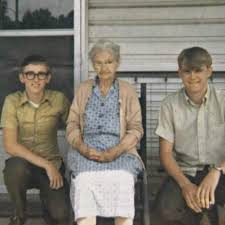
Lucy Smith Stanley
8/10/1888 – 2/24/1973
Dickenson County, McClure
Hear Ralph Stanley talk about his mother’s playing and play a medley of her tunes.
Besides being a master and teacher of clawhammer banjo, Lucy (Smith) Stanley raised two of the most famous musicians in Virginia’s history. Her sons, Ralph and Carter Stanley learned their love of music at home, from their mother and went on to be the founders of the Stanley Brothers band. Born on Smith Ridge, deep in the Clinch Mountains, Lucy learned to play clawhammer banjo as a young girl, she quickly developed into an accomplished player at a young age. This was due largely to the fact that Lucy had 12 brothers and sisters, all of whom played clawhammer banjo.
Lucy’s banjo learning was peer driven and became part of what folklorists call “kinship language.” Married at a very young age to Watson Rakes, she became a widow early in life. Her second husband, Lee Stanley, that she married in 1924, did not play an instrument but was known for his ballad singing. He knew ancient songs like “Man of Constant Sorrow,” which became part of the early homelife of their two sons, Carter, born in 1925, and Ralph who came along in 1927. Lee was a singer in the Primitive Baptist Church, nearby and taught Carter the intricacies of mountain church singing. Lee and Lucy were separated when Carter was 16 and Ralph was 14.
After Lee’s departure, Lucy was left to raise her teenage sons alone on Smith Ridge. There she taught her youngest, Ralph to play the banjo in the ancient style of the Smith clan. According to Carter, Lucy’s playing that he called “the old drop thumb,” was not only “smooth,” but he went on to recall that “her time was good, as good as anybody else’s.”
Ralph Stanley picked up a time proven repetiore from his mother. According to Ralph, the first tune he learned from her was “Shout Little Luly,” a pre-civil war tune. She also taught him to play “Little Birdie,” “Chinquapin Hunting,” and “Cripple Creek,” all of which Ralph would include in his highly successful commercial concerts for large audiences long after his mother was gone. Although Ralph would go on to learn both two finger and three finger “up picking” styles, he always remembered his mother’s teachings.
Although Lucy was never recorded, Ralph made sure in both his performances over many years and on his recordings to display his mother’s style and teachings to wide audiences. Long after his mother’s death in 1973, Ralph recorded a collection of his mother’s tunes, played in her powerful rhythmic style, 1991’s “Songs My Mother Taught Me” contains 18 tracks of Ralph playing Lucy’s tunes as closely to her Smith Ridge style as he could play them. The compilation stands as a testimony to Lucy’s playing.
Lucy Stanley lived a very hard life in which music provided a needed soulful relief. Among her many tragedies, the local paper reported that five of her 12 siblings took their own lives. Poverty and isolation were also a part of Smith Ridge living, but the success of her two boys playing and singing the music they learned up on the Ridge gave her great joy.
Lucy stands as a strong reminder of the importance of family and particularly parents in imbuing a love for music in their children. She, like her contemporary Maybelle Carter, made sure her children could always find joy and solace in communicating through music. The family setting is one of the most powerful contexts in which to begin the journey of becoming a master of any instrument.