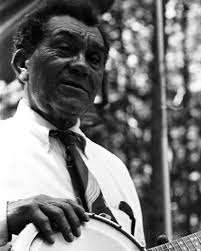
Homer Walker
2/15/1898 – 1/4/1980
Giles County, Glen Lyn
Hear Homer Walker play “Sugar Hill”
If you listen to Uncle Homer Walker’s “Sugar Hill” (above,) you won’t hear the same tune that is commonly played in clawhammer jam circles. That’s because Homer’s version harkens back to a much older clawhammer tradition, one that grew out of the incredible mixing pot that was and is, Giles County, VA., down where the New River crosses into WV. There, in Glen Lyn, was the perfect place for Homer to hear the African American roots of the banjo, and to learn music from a variety of folks from different traditions who came through the region working on the river, building the rail lines and yards and the local fiddle traditions such as that of the Reed family.
Homer was born in the borderlands of Virginia and West Virginia into a family where musical talent was widespread. His father, a sharecropper, played the banjo and his siblings played the fiddle, guitar and mandolin. Born at the end of the 1800’s, before the blues tradition had fully emerged in black families, Homer learned the music of his family, including his maternal grandfather, who had been born into slavery in Virginia. When Homer began playing clawhammer at the age of eight, he was steeped in the mid-19th Century styles and tunes that pre-dated the 20th Century stylistic shifts. He became a living archive of pre-industrial African American music in Virginia.
According to scholars like Cecilia Conway and others, what we know as “old time” music that is currently often associated with white musicians was built upon the techniques, tunes and tunings that were common in African American music circles. It is the mixing of the Scots Irish fiddle music brought by White settlers to Virginia, with the African instrument, the gourd banjo, that created the genre we now call “Old Time.” Homer’s playing represents the synthesis of these two styles.
Homer’s tune collection included 19th Century folk music, spirituals and secular dancing tunes that had been passed down through generations of his family. His repertoire included such standards of both worlds as “Cripple Creek,” “Old Joe Clark,” “John Henry,” “Steal Away,” and “Sugar Hill.” A very interesting fact about Homer’s playing as an African American artist was that he claimed he did not hear or learn blues banjo music until his later career in the 1960’s and 70’s when he travelled to folk festivals. His musical education had been “pre-blues” music from string bands and earlier spiritual traditions.
Homer lived through the transition of Black music in America to the dominant blues form, but he remained primarily rooted in the older community dance music of the 19th Century. His career was important to scholars of American music because as a Black performer, he didn’t fit the “country blues” stereotype that was created by record companies and “race records.” African American string bands were rarely recorded, and Homer’s contributions are vital to understanding the trajectory of clawhammer playing in Virginia.
Homer was renowned in his adult home of Glen Lyn and around the local region until the great “folk boom” of the 60’s and 70’s. He became a visible, prominent practitioner of early black Appalachian music in venues that were often limited to white revivalists. In the 1970’s, particularly, Homer became a familiar face on the festival circuit, playing at such prestigious events as the John Henry Folk Festival in WV, the Smithsonian Folk Festival in Washington, DC, and the Vandalia Gathering.
In 1977, Homer’s life and music were documented in a short film entitled “Banjo Man,” that was directed by Joseph Vinikow and Reuben Chodosh. The film was narrated by the influential country blues performer Taj Mahal. He was also featured in the 1972 documentary “Morris Family Old Time Music Festival.
Although Homer labored hard in Glen Lyn most of his life, his musical contributions to the history of old time music in Virginia live on and probably will live on. He gave us a good look at something that is mostly lost to history, the importance of African American banjo to today’s old time sound.