George Stoneman
12/26/1882 – 3/23/1966
Carroll County, Galax
Hear George Stoneman play Sally Anne
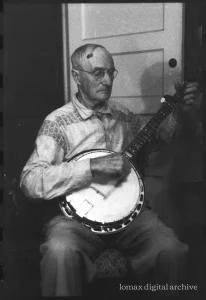
George Stoneman, although from a family that later became stars of the early commercial era of country music, preferred to remain rooted in the local style of clawhammer. His legacy represents the early “Galax gallop” approach to clawhammer banjo. He never traded his rhythmic drive for the more melodic styles prevalent elsewhere.
Born into the famous Stoneman family, George Washington Stoneman was first cousin to Earnest “Pop” Stoneman of early Nashville fame. It is thought that the older George was instrumental in helping to raise his motherless cousin and helped, at a young age, to educate Earnest in the music of the Galax area.
George learned his music in the community of Galax, developing a playing style that musicologists have often compared to the classic banjo styles of the minstrel era of the mid 19th Century. His playing was resemblant of the “stroke style” reportedly preferred by minstrels and local African American players, who were never recorded for a variety of reasons. George often referred to it as “breakdown style.”
George’s first foray into commercial music was in 1926, when his cousin, “Pop” talked him and a small group of musicians from Galax to travel with him to New York. Pop had tried, unsuccessfully, to emulate the success that Henry Whitter of nearby Fries had. Henry previously recorded (1924) for Okeh Records a failed autoharp, harmonica and singing album, solo. His second time around he recruited George to play banjo with him, along with Pop on guitar and vocals, and both Uncle Eck Dunford and Kahle Brewer on fiddles. Calling themselves “The Dixie Mountaineers, they created a successful dense, driving sound that George provided the rhythmic bed for. They were so much more successful, recording for Victor, Edison, and Gennett Records.
In 1927, George was recruited by Ralph Peer to help with the infamous “Bristol Sessions,” and he was one of the most recorded individual musicians during the sessions, playing banjo with “The Stonemans,” “The Blue Ridge Corn Shuckers,” and with “Dad Blackard’s Moonshiners” that included the Shelor family from Meadows of Dan. On the “Corn Shuckers “ tracks, George not only played banjo but was active in the skits about “passing ‘round the jug.”
The depression of the early 30’s caused Pop to seek work in Washington DC, where he reorganized “The Stonemans” and began to actively market the act commercially. George chose to stay in Galax, where his banjo playing remained true to the Galax sound. George became a stalwart of the Galax Old Fiddler’s convention, attending every year, and winning 2nd in banjo in 1940 and winning first, 20 years later, in 1960 and 2nd again in 1965.
In 1959, George was “discovered” by noted folklorist Alan Lomax, who came to his home and recorded not only George, but a variety of his friends including fiddler Uncle Norm Edmonds. Later, in 1965, collector Charlie Faurot, working with Dave Freeman’s County Records, recorded George and a variety of clawhammer players to represent the regional styles on a collection called simply “Clawhammer Banjo.” George was one of the masters that Faurot specifically came to record along with Kyle Creed, Wade Ward, and Fred Cockerham. That classic collection is considered required listening for anyone learning the clawhammer style.
Although he never obtained commercial fame like the cousin he helped raise and nurtured a love for music in, George Stoneman helped define the Galax sound.