John Rector
4/10/1877 – 4/10/1905
Grayson County, Fries
Hear John Rector play “Black-Eyed Susan” with Henry Whitter and James Sutphin
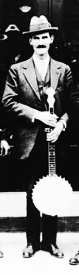
Sometimes referred to by folklorists as “the other John Rector,” John William Rector was born in Grayson County, VA, close to where the company mill town of Fries would soon be built. Born into a fairly wealthy family, as a young man John discovered the banjo through a variety of relatives in the area. As the Washington Cotton Mill at Fries was completed, John became the manager of his family’s store just outside the new company town.
There, while minding the store, he invited many of the mill workers to come to the store and idle away the hours with him. One frequent visitor was Henry Whitter, a mill hand who was destined to become one of the original singers of “hillbilly” or “old time country music.” Later in his career, Whitter would join with fiddler J.P. Grayson, and later young Albert Hash, and became nationally known. Many of the songs he introduced in the early days of radio and recording are still popular today.
In 1924, after a couple of solo trips to record with recording pioneer and raconteur Ralph Peer, Whitter’s music was being played around the country. To bolster his sound, Whitter recruited a band to back up his vocals, just as another of Peer’s successful “old timey” musicians, fiddlin’ John Carson had done. Rector travelled to New York with Whitter and a fiddler named James Sutphin. They travelled in Rector’s 1923 Ford and made record time getting to the city.
In New York, “Henry Whitter’s Virginia Breakdowners” recorded six sides for Peer’s Okeh Records. When Rector heard them, he was extremely disappointed in the outcome, feeling that the band sounded “unpolished,” and called the recordings “lacking.” He parted ways with Whitter who was apparently satisfied with the recordings which were released. Back in Fries, John Rector formed a new band after walking down the street in nearby Galax and hearing a barber, Tony Alderman, playing the fiddle while one of his clients, Joe Hopkins backed him up on guitar.
John soon asked Hopkin’s brother Al Hopkins, who played the piano and sang well, to join the trio and they began to practice regularly, either at Tony’s barbershop in Galax or at the store in Fries. Having learned much about the recording business from his experience with Whitter, he soon talked his new band into traveling to New York to see Ralph Peer. In January of 1925, the group traveled in Rectors’ Ford and landed at Okeh records.
When Peer met them at the studio, the first thing he wanted to know was the bands name. Being in promotions, Peer was consciously building a new category of rural-based recordings to market to the majority of Americans living in the country. Al Hopkins looked Peer straight in the face and retorted, “Call us anything you want. We’re nothing but a bunch of Hillbillies from Virginia and North Carolina anyway.”
Peer, seizing on the moment in time, recognized the marketing potential. Later that year, the “Hill Billies” first recordings were released and sold voraciously across the country, being played on radio stations hungry for the “new” rural sound. Soon, the recordings in the entire new genre were called “hillbilly recordings.”
Rector’s playing was strong rhythmically, and was characterized by a new sound. He incorporated a “cluck” or “thud” that he made by dampening the strings and in so doing was able to drive the feet of dancers. After the 1925 sessions, Rector returned to shop keeping and opened a second store in East Radford. In 1927, just as the “big boom” of country music was taking place with Peer in Bristol, he died, unexpectedly at the age of 50.