Posey Foddrell
12/9/1898 – 12/19/1985
Patrick County, Stuart
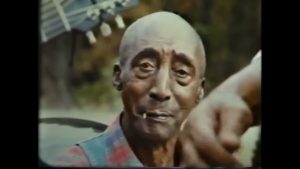
No known recordings of Posey Foddrell playing banjo are available
According to Posey Foddrell’s son, Turner, his father was probably a link to a much older time: “My daddy was one of the last Black clawhammer players in this area. There used to be lots of Black fiddlers and banjo players around here, but daddy was one of the last in this area,” he told a reporter. Posey was a talented musician who could play not only banjo, but guitar, mandolin, piano and organ. His legacy as both a musician and teacher lives on.
Posey was born and lived his entire life in Patrick County. His father, Scrap Carter taught Posey the clawhammer style. Scrap had learned to play before the civil war and played music all of his life. Posey, in turn, made music one of the foundations of his life. “I played music for White folks all up and down these roads for most of my life,” Posey told a documentary crew, “It was part of who I am.” He started playing dances with his father and also had bands of his own.
After marrying another musician, Alice Edwards, the two set about raising a musical family. Posey and Alice had five sons, and a daughter, and all became talented musicians with distinct styles. Two of his sons, Turner and Marvin, after learning the basics of playing from their parents, became great players of Piedmont blues and were featured on several recordings as well as making appearances on international stages. They made it a point to incorporate both their father’s old timey tunes and his guitar in their performances.
Posey’s style of clawhammer playing was described best by Brien Fain, clawhammer master, who would visit the neighboring Foddrell family with his father, an old time fiddler, “He played straight old time music,” Brien said, “but one of the things Posey taught me was to add some “moan” to the music.” One of the ways that Posey got the “moan” was string bending with his left hand on the third string. Fain learned many tunes from the elder Foddrell as a very small boy.
Another influential musician who visited the Foddrell house as a young boy was legendary bluegrass banjo player Sammy Shelor who also grew up in Patrick County. While learning to play as a young boy, his family would often listen to the Foddrell’s. On his recording with bassist and singer Linda Lay, titled “Taking the Crooked Road Home,” Sammy is quoted by musicologist Joe Wilson as saying “Everyone should have seen and heard the Foddrell’s.” According to Wilson, Sammy revered Posey and his family.
Posey played in a band with his son and with Patrick County neighbors and was a much sought after musician at local square dances, house frolics and play parties. One of the things that characterized his was the sheer joy of making music. “I’ll tell you, if you’re a music maker and and you’ve worked hard all day and feel tired and broke down,” Posey said, “If you come home and eat your supper, mess around a little bit and then start playin’ music, it’ll rest you. You’ll feel better right away! It was for me. I could work hard all day and then feel better.”
Posey’s joy of playing music was contagious and thanks to his very musical legacy we have a small window into the history of clawhammer banjo in the United States. As primarily an African immigrant to our country, more work needs to be done in researching and preserving Black clawhammer masters and their importance in the history of old time music.