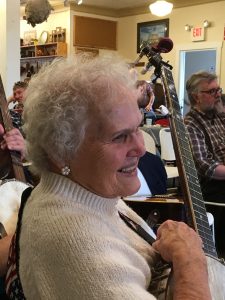
Rhoda Kemp
11/13/1930 –
Roanoke County, Roanoke
Watch and Hear Rhoda Kemp and Friends play “Ragtime Annie”
As a young girl growing up on a farm outside of Roanoke in the depths of the great depression, Rhoda Kemp was surrounded by music. “I just can’t remember a time when there wasn’t music around me,” Rhoda said, “My earliest memories include banjos, fiddles. and guitars.” Everyone played something, and on family music nights her parents, her three brothers, her sister, her grandparents, aunts and uncles and neighbors would gather joyously many nights of the week to play music.
At the age of six, Rhoda taught herself to play guitar and inserted herself into her brothers’ nightly music jams. At first the older boys thought it was cute to have their little sister playing, but they already had a guitar player. When she was 10 or 12, her brothers had had enough cuteness. “If you’re going to keep playing with us,” they told her, “Then you oughta’ learn the banjo. We don’t have a banjo player.” Thus began Rhoda’s more than. 80 year obsession with clawhammer playing.
At first, Rhoda learned by listening carefully to local radio broadcasts. She particularly loved the playing of early banjo stars like Stringbean and Grandpa Jones. She tried hard to emulate their styles, and playing nightly with her siblings helped her develop a great sense of rhythm and to learn a large repertoire. But to Rhoda, something wasn’t right about her playing. She just couldn’t get the sound she heard in her head. Still, she was good enough to accompany the family band, to play out for dances and community events.
At the age of 20, Rhoda married and began to raise her seven children, and like most musicians, that duty moved music to a “back burner.” She didn’t stop playing, but she didn’t have much time to improve her technique. Then, in 1969, she went with a friend to visit banjo legend and banjo builder Kyle Creed in Galax. “What am I doin’ wrong?” She asked Kyle. The wry old master just began to laugh, “Let me show ya’ a little something,” he said. Immediately Kyle took a liking to Rhoda and the two began to meet regularly.
“He was a great player,” said Rhoda, “But he wasn’t really a teacher. I’d ask him ‘How do you play that “Fire on the Mountain,” Rhoda remembered, “And then he’d play me the whole first section, up to speed, without slowin’ it down. So, I just had to speed up my learnin,’ She laughed.
Quickly, her style began to change and grow, and soon she could play just the way she heard the tune in her head. She developed a sharp attack and a precise, driving rhythm of her own. “My style just started to come out,” she remembered. “It wasn’t Kyle’s style – he was much more ‘notey.’ It wasn’t the Galax sound – that had much more ‘gallop’ to it. It was my style,” Rhoda said, “A much more driving style, something that could stand out next to the fiddle. It felt great to play.”
Soon, with her sister Iva on bass, her brothers Ebo and Marvin on guitars, and her brother Jewel on fiddle, and driven by Rhoda’s newfound drive, the band became an institution at dances, conventions, and concerts across SW Virginia. Sadly, though, in 1977 her oldest brother Jewel died of a heart attack and the family band lost its appeal for her brothers. Rhoda, however, kept working on her style and approach, developing a what’s come to be known locally as the “Rhoda Rake,” a quick and powerful brush across the strings to build tension and emphasis in her playing.
In 1980, she joined an established band called “ The Original Orchard Grass,” that was a dance band, playing strictly fiddle tunes, and they quickly became the go-to dance band in the Roanoke Valley. In 2025, Orchard Grass, with Rhoda on banjo and sometimes autoharp, can still be heard playing at the Country Store in Floyd. The ‘Rhoda Rake’, at the age of 95, lives on both in Rhoda’s playing and in the styles of the many students she has mentored.