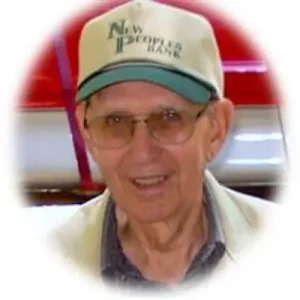
Johnny Osborne
11/21/1922 – 12/6/2009
Russell County, St. Paul
Hear and watch Johnny Osborne and his father, Uncle Charlie, play “Little Brown Jug”
The oldest form of musical learning in SW Virginia has always been familial based. When regional musical styles are transmitted in the immediate family and reinforced by community members and friends, that transmission seems to last a lifetime. Johnny Osborne, of rural Russell County is a great example of family tradition. His father, Charlie Nelson “Uncle Charlie” Osborne was his primary musical teacher, and, as in many Appalachian families, music was a primary medium for both family bonding and the family’s social cohesion.
“Uncle Charlie” had also learned to fiddle at a young age and from the age of 15 until his death at the age of 101 was regarded as one of the best regional fiddlers. He was a contemporary of Jimmie Rodgers and the Carter Family and played regularly on local radio in Bristol, TN. His son Johnny started joining him on stage and on radio as young as 10 and became Uncle Charlie’s go-to clawhammer player for many years.
Although born on his dad’s farm, Johnny was part of the first generation of young Appalachians to make the shift from rural agrarian life to working in the industrial revolution. Luckily, his banjo travelled with hime.Working for Georgia Pacific Railroad, he was exposed to a variety of musical traditions and a variety of musicians who both encouraged and contributed to his vast banjo tune list. Also working in a factory owned by British food manufacturers “Crosse and Blackwell” (later to be acquired by Nestle) he met folks from across the world, and as at many Appalachian factories of the era found break time and after work “mill jams” helped broaden his banjo skills.
In 1999, Johnny returned to Russell County and re-established himself in the musical community, becoming a vital part of the old-time community for the next ten years. Much of his last decade was spent travelling to SW Virginia festivals and contests, sharing his family’s musical traditions and performing at local gatherings.
Johnny’s clawhammer style remained true to the style that his father taught him and by playing with his octogenarian father in competitions and concerts, he helped keep the family legacy alive and vital. Charlie received a commendation from the Virginia Governor for his lifetime contributions to old time music and Johnny was right there, by his side, to assist his father’s playing. Through industrialization and through cultural disposition, he kept his family musical traditions well.