Hobart Smith
5/10/1897 – 1/11/1965
Smyth County, Saltville
Hear Hobart Smith play “Last Chance"
Music pioneer and Father of Bluegrass Music, Bill Monroe once said, “Hobart Smith is the best old time banjo player I ever heard.” Hobart’s life was, from the beginning, immersed in music and hard work, both leading him to a high chair in the masters of clawhammer banjo in SW Virginia.
Hobart was born into music. Both his mother and father were banjo players, and being the eldest of eight children, he naturally absorbed his parents love for the instrument. His surroundings in the town of Saltville were both those of rural agrarian culture but also, due to the existence of large salt and gypsum mines that fed the area’s economy, an industrial region that had a diverse population. Unlike many isolated players on the Blue Ridge, Hobart absorbed musical influences from other cultures, particularly from Black neighbors.
The musical heritage in Hobart’s family extended back at lease seven generations, including two grandfathers who were fiddlers, and a deep pool of ballad and hymn singers who were key to his musical learning. However, it was his immersion in the sounds and styles of the African American players outside his family that would transform his musicianship from just accompaniment to virtuosic solo playing and singing.
Though Smith said it was a white neighbor, John Greer, that was his primary banjo teacher, showing him “double noting” and other techniques, Greer had learned to play from the African Americans working in the mines. One of those teachers was a Black banjoist from Laurel Fork, VA. by the name of Henry Hays, of which very little is known. Hobart’s blues guitar style was, according to Smith, directly learned from Jim “C” (Crouch) who taught him to play and sing tunes like “Railroad Bill.”
Hobart’s earliest memories, however were sitting in front of the fireplace hearth, late at night, with his sister, Texas Gladden, by his side, singing ancient ballads and hymns. Texas would go on to have a long career as a ballad singer and entertainer, beginning with the White Top Mountain Festivals in the 1930’s.
Often characterized as possessing “that high lonesome sound,” Hobart did not come by it easily. In 1946, he told Folklorist Alan Lomax that at times his family had faced starvation, and recalled a brutal winter when his father had to drag a sack of corn across the mountains during a blizzard to feed his starving family. Music, became a way for the family and especially Hobart and Texas to escape their harsh reality.
At the age of seven, Hobart’s parents, who had watched him repeatedly try to play along with them as a toddler by trying to strum an “old fire shovel,” bought him his first real banjo. At the age of 14, his family took on a boarder, Jim Spencer, an African American fiddler, who was a former slave. This relationship gave Hobart access to many older tunes, like “Jinny Put the Kettle On,” and taught him about “blue notes” (microtonal flatting of the third and sevenths) as well as an emphasis on syncopation rhythm over melody. Inspired, Hobart began sneaking over to the segregated side of Saltville to hear more. Soon, Hobart broadened his playing to incorporate the blues guitar and even the piano.
In 1915, as a teenager, Hobart had a short stint of the minstrel circuit. Following that, he settled into a life of labor, becoming a farmer, housepainter and a butcher. For a period of 25 years, he stopped playing the banjo. This hiatus from music was broken in the early 1940’s when Pete Seeger, searching for banjo players in the South found Hobart and arranged for the Vega banjo company to send him a brand new high quality banjo. Hobart told Lomax, “In 30 days I was back, just as good as I ever was.”
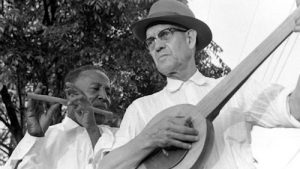
Hobart became a hero of the folk revival of the 1950’s and 1960’s thanks to recording efforts by Alan Lomax, Pete Seeger, Fleming Brown, and banjoist and scholar Stephen Wade. He played mostly on a resonator Gibson banjo, but also loved to play his powerful bluesy style on a fretless mountain banjo that allowed him to slide into flatted notes. He put bluegrass fingerpicks on backwards to ensure he could be heard. One of his favorite pieces, learned from his father was “Last Chance,” a banjo solo that is still a favorite at competitions.
Hobart left a long legacy of recordings, starting with the Lomax tapes in 1940’s. In 1946, he went to New York and recorded sessions for Decca records. In 1963, he travelled to visit music teacher Fleming Brown at the Chicago Old town School of Folk and recorded with Brown in his living room, including telling stories and even dancing in the background. In 1964 he recorded an album of his own for Folk-Legacy Records.
Hobart’s last major public performance was at the Newport Folk Festival where he shared the stage with Seeger and revivalists like Bob Dylan and Joan Baez. He became a singular, powerful force in American Folk, riding his archaic banjo style into the history of American Music.