Matokie Slaughter
12/21/1919 – 12/31/1999
Pulaski County, Pulaski
Hear Matokie Slaughter play “Big Eyed Rabbit”
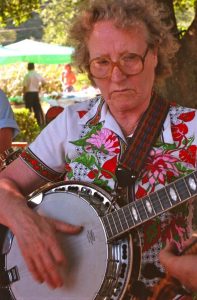
Matokie Slaughter (“Tokie”) was born into the musical Worrell family in Pulaski. She heard and learned to play the music of the mountains on both banjo and fiddle, integrating her playing into the family string band. By the time she was a teenager, in the 1930’s she was an accomplished clawhammer player, making frequent local radio appearances with her kin. She developed a heavy, driving right hand that carried the family band frenetically. She was also very bashful, at first, and let her heavy, wild style do the talking for her. Early on, most listeners assumed, based on listening, that she was a man and were quite surprised when she appeared in person.
Beside playing on the radio, Matokie and her relatives were frequently featured at local corn shuckings, family celebrations, auctions and dances: all places that required a heavy, loud frailing that could be heard over the noise of crowds. Her heavy handed style was taught to her by her father, who was an accomplished performer.
He taught her rollicking tunes like “Big Eyed Rabbit,” and “Stillhouse,” that lent themselves well to a forceful style. In the 1940’s, the family band consisted mostly of her numerous brothers, and Matokie’s gender was often confused by listeners. By that time her style had become complex, including double-noting, and very tasteful up-picking notes as part of her clawhammer down-stroking, a unique aspect of her playing..
Matokie’s lifelong musical companion, however, was her sister, Virgie, (born Virginia Worrell) who played guitar and banjo alongside her. From the early 1920’s until Matokie’s death in 1999, Virgie was there, joining Matokie in nearly every adventure she undertook. Together, with her brothers and father, the girls were integral to the “Worrell Family Band” throughout the 1940’s and 1950’s.
In 1951, Matokie married Ennis Slaughter who came from Indian Valley in Floyd County. He and Matokie settled down in Pulaski and set about raising two children and Matokie didn’t play out for several years. During the “folk boom” of the 1960’s and ‘70’s, Matokie was coaxed by her sister to return to playing and two became frequent contestants and entertainers at festivals and contests across SW Virginia.
In 1967, Charles Faurot along with his friend Dave Freeman, attended the Galax Fiddler’s convention. The two song collectors and producers had been toying with the idea of putting together a collection of clawhammer banjo players, and decided to rent a house near the Galax fairgrounds and invite clawhammer masters to come record there, during the convention.
During that week they recorded the likes of Kyle Creed, Tommy Jarrell, Fred Cockerham, Gaither Carlton, Sidna Myers, Oscar Wright and Matokie Slaughter.
In 1969, Faurot released “More Clawhammer Banjo Songs and Tunes From the Mountains” on County Records. Matokie’s two contributions, “Big Eyed Rabbit” and “Stillhouse” became classic releases on the album and got the attention of a national audience. Matokie and her sister became in demand and they added a rotating variety of musicians to their performances throughout the 1970’s, performing as “Matokie Slaughter and Friends..” Those recordings have been re-released on a popular three CD compilation simply titled “Clawhammer Banjo.”
In the 1980s’’s, renowned folklorist and musician Alice Gerrard met Matokie after having moved to the Galax area. She. along with Matokie’s sister Virgie and Matokie formed “The Backstreet Buddies.” The trio became quite popular at festivals including The Augusta Heritage Festival in West Virginia. Together, they recorded one album, that was released one year after Matokie’s death. Originally a cassette put out by the Marimac Label, it was later reissued. Although it was late in Matokie’s life, her clawhammer playing is as strong and driving as ever.
Following Matokie’s death, a strange but sweet homage was paid to her by a folk and graffiti artist by the name of Margaret Killgallen. A banjo player, Killgallen often tagged freight trains with “Matokie Slaughter” as a homage to her banjo playing hero and Matokie’s name began to appear on buildings and trains across the country.