John Lawson Tyree
1914 – 1982
Franklin County, Franklin
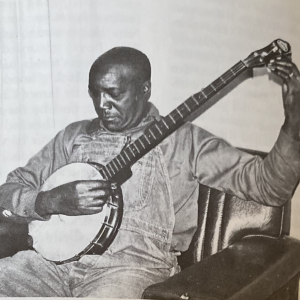
Hear John Tyree play “Fox Chase”
Sadly, the history of the African American string band sound, and particularly the African sounds of the banjo, has nearly been obscured in our history. We know that our current clawhammer styles are the result of cultural synthesis, growing out of gourd instruments with hemp strings that were played in Virginia long before the modern day fascination with Appalachian old time music. There are, however, important links to this vital history, and one such link is found in the playing of John Lawson Tyree, who grew up in the rural landscape of Franklin County, near Rocky Mount, in the Sontag area.
Although we are not sure of the actual dates, we know that John was born in either 1914 or 1915, and passed away in 1982. The social life of Sontag revolved around house dances and play parties that were often held in the basements of the community members. John hosted many of these get-togethers and we know that he hosted one as late as 1972 in his own basement. This represents one of the last documented of this community dance tradition in the area. These dances included squares, rounds, marches as well as spontaneous buck dancing and flatfooting.
John learned clawhammer from both his father and his uncle, Torrance Wade, who favored the older clawhammer style. John made his first banjo when he was in his late teens with his father’s help. Thanks to the scholarship of Ferrum College’s Kip Lornell, an ethnomusicologist, who recorded John in the 1970’s we know that he had a diverse repertoire that included standard dance tunes, ballads and some novelty tunes that showed his banjo prowess.
In this context, John Lawson Tyree can be seen as a direct link, a cultural custodian of a nearly vanished American musical tradition and certainly part of a “hidden history” of Blue Ridge music. His rendition of the classic “Cuckoo Bird” where he imitates the call of the cuckoo, as well as the dance tune, “Hop Along Lou” stand as testament to the broad influence of the African American clawhammer tradition on the much broader American musical landscape.
John’s playing, as recorded by Kip Lornell, is featured on three Smithsonian Folkways releases: “Virginia Traditions: Non-Blues Secular Black Music,” the very popular “Black Banjo Songsters of North Carolina and Virginia,” and a release entitled simply “Classic Banjo.” The creators of this site highly encourage readers to listen to each of these seminole releases to hear the earliest remnants of clawhammer banjo, in its purest form.
Thanks to great masters of the art like John Tyree, who dedicated their lives to preserving a vital link to our musical heritage, to our past and into the importance of devoting our musical talents to preserving these traditions. Thanks to the work of great preservationists like Kip Lornell, John Lawson Tyree continues to give us his greatest gift, his music.