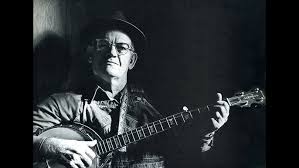
Abe Horton
4/11/1917 – 2/8/2004
Carroll County, Fancy Gap/Laurel Fork
Hear Abe Horton play “Ida Redd”
“The frets on a banjer for old time music, well them frets is just in the way,” Abe (“Abie”) Horton once told a reporter, “You can get a better sound without them frets,” he said. Abe learned to play on a fretless banjo that his father made for him at age five and never looked back, becoming one of the most recorded clawhammer players in the region.
Abe came to playing music through genetics and heritage. His father played, his grandfather was a fiddler, his great grandfather fiddled and so on, as far back as his family history is recorded. Growing up along Big Reed Island Creek in Carroll County, it wasn’t hard to find someone to play with, and Abe did. He remembers going to a local dance at a nearby log cabin at age 12.
“My daddy give me orders to stay out of the way of the dancin’,” recalled Abe, “Theys’ havin’ a workin,’ a wood getting’ and a dancin’ that night. I just stayed in the kitchen. It wasn’t long before the banjo player, a man named Oscar Cruise came in the kitchen of the cabin to take a break and do some dancing. He grabbed young Abe, set him up on top of the cookstove, handed him a banjo and told him to start playing. “The first you knowed, I had a bigger crowd in that kitchen than they had in that dancin’ room!” remembered Abe.
After that night, Abe’s reputation in the Fancy Gap and Laurel Fork areas began to grow and he became a much sought after musician for dances, house parties and school house gatherings. His style was melodic, with hard driving rhythm all around the melody. He drew a sharp distinction between his style, the mountain banjo style and the increasing popularity of bluegrass. “Well, you see,” Abe said, “In old time music, if you’ll notice, the strings just say the words. An the bluegrass don’t. If’n they don’t sang them, you wouldn’t know what they was sayin.’”
Abe was a strict traditionalist when it came to old time banjo playing. He grew up in a tradition where the banjo and the fiddle locked into the melody and stayed joined, in the ancient tradition of the region. “If them’s playin’ chords on the banjo, them ain’t playin’ old time,” Abe told the Mountain Laurel magazine, “You don’t put no chords in old time music when it comes to the fiddle and the banjer,” he said, “But you see in bluegrass you chord the banjo and also the fiddle.”
Abe Horton’s reputation as a banjo player really took off during the folk revival years of the 1970’s when he was “discovered” by both folklorists and musicians. Players like Alice Gerrard and Brad Leftwich came to play and record with him and during that time he recorded four records with Bobby Patterson’s Heritage label in Galax. In 1977 he was invited to play at the National. Folk Festival near Washington, DC.
Maybe his most important musical relationship came about in 1972, when he met a blind musician from Richmond at a fiddler’s convention in Saltville. Harold Hausenfluck and Abe formed a musical relationship that resulted in both players achieving the best playing of their careers. Hausenfluck, who had a very keen and critical sense of hearing banjo and fiddle music, took to Abe’s precise yet melodic style of playing right away. “Now Harold,” Abe commented, “he plays old time music, that’s one thang about him!” Abe and Harold cut two albums together that received very strong reviews.
In the 1970’s Abe organized a group of local musicians to form the “Pine River Boys” a group that featured Abe on both the banjo and fiddle and performed tirelessly for local dances and fiddlers’ conventions throughout the decade. Abe’s version of “Poor Ellen Smith” in which he plays a two-finger style of “seconding” banjo is considered a classic.