Chris Via
3/24/1974 –
Giles County, Rich Creek
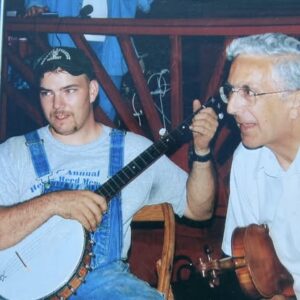
Chris Via and Jimmy Costa play Henry Reed’s “Foldin’ Down the Sheets”
The New River charges through the border line of Virginia and West Virginia and brings both water and music through Giles County. This region of SW Virginia has its own musical heritage and Chris Via is not only a clawhammer master of the region, but is a preservationist, dedicated to preserving this region’s contributions to Appalachian music.
Chris, who was born just over the Virginia state line in Princeton, WV, has lived his entire life in Giles County. Although there were musicians on both sides of his parent’s families in his hometown of Rich Creek, and old time music served as a background to family gatherings and community events when he was young, he didn’t really appreciate mountain music until he was out of high school.
When Chris was 15, his father moved to Florida and Chris briefly moved with him. When he was 19, feeling homesick for his home in Virginia, he bought a banjo in a pawn shop to feel closer to home. A year later, with his banjo in hand, he returned to SW Virginia. His older cousin, Roy Pendleton was an accomplished banjo player and began to show Chris the clawhammer licks of the region. After a couple of years of woodshedding, Chris had accomplished a few tunes including, “Jack Rabbit in the Snow” from local fiddle legend Henry Reed, as well as “Sweet Sunny South” and “Fly Around My Blue Eyed Gal.”
In the late 1990’s Chris began to play regularly with an older fiddler, Fleming Thornsbury, from Camp Creek WV. Together with his cousin, Roy on harmonica, the three put out a cassette tape called the “Giles Mountain Boys.”
About this time, Chris became aware of the musical treasure trove in his community, the legacy of fiddler Henry Reed. Chris had always known the Reed family, Henry’s sons, who mostly lived as neighbors to him. Dean (T-Baby) Reed, Henry’s youngest son who owned a local radio station, became a good friend and musical companion of Chris’s. When a newspaper article came out about Henry’s playing and the young folklorist at the Smithsonian, Alan Jabbour, who had made many trips to the area to record Henry and his sons, Chris became aware of the importance of Henry’s music. He slowly began to dedicate his life and his music to Henry and his family’s legacy.
Chris became aware of a “tape tree” of Henry Reed music that was being passed around the regular jam in nearby Blacksburg, VA and decided to start attending the Blacksburg jam. There he met fiddler Bill Blevins, who was also consumed with Henry’s legacy and the two became close friends and musical collaborators, right away. He also met another local fiddler, Jimmy Costa, who knew a lot of Henry’s repertoire and soon he was forming a band just for the purpose of keeping Henry’s long list of tunes, captured by Alan Jabbour alive. Dean Reed became an important part of the music scene Chris was forming and with visits from his three brothers, peppered Chris with stories and lore about Henry’s life.
Around 2003, Alan Jabbour came to the area to play a concert of Henry’s tunes and asked Dean and Chris to accompany him. While he was visiting the region, Chris hit on the idea of having an annual fiddle festival and contest dedicated to Henry’s memory and the Henry Reed Fiddle Festival was born. He coaxed all of Henry’s sons, Neil, James , Dean and Gene to participate and each festival would start with “The Reed Family and Alan Jabbour,” sharing Henry’s tunes with Chris on the banjo. Around this time, Chris also became serious about playing the fiddle, to continue his work in preserving Henry’s music.
Chris developed a special relationship with James Reed. “James was the guru of old time guitar, for me,” Chris recalled. The Henry Reed conventions became quite successful and the older musicians in the area began to really encourage Chris’s efforts to memorialize Henry’s music. When James died at the age of 87, Chris focused his attention on Dean, the remaining son of Henry.
A group of local musicians, including Matt Peyton, Bill Blevins, Russ Boyd and Tim Thornton joined Chris to play regularly with Dean Reed in Dean’s last year, to help the elder Dean enjoy the music of his father. When Dean died in 2024, the band, called “The Reed Tradition” began to share Henry’s music across the region and on social media. Chris’s mission he says, “Is to keep the “powerful and lonesome” sounds of Henry and his family stories alive.”