Debbie Grim Yates
6/24/1971 –
Smyth County, Konnarock/Damascus
Hear Debbie Grim Yates play “Cindy” with the Konnarock Critters
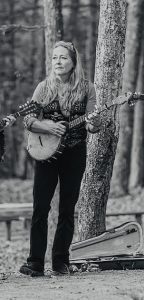
Debbie Grim Yates is a living embodiment of one of SW Virginia’s clawhammer scene’s tenants – the importance of both family and community in contributing to musical accomplishment. Like many others, Debbie’s maternal grandfather was a fiddler. He lived and played the music of the White Top Mountain region, where Debbie has lived and played most of her life. She and her older brother, Brian, were exposed to music at a young age, not just from their grandfather, but from the playing and ballad singing of their mother. This exposure at a very young age seems essential to the torchbearers of regional style.
Debbie is a product of what has become known as the “White Top Style” an approach to the banjo that is very different from those found in the Galax or Round Peak regions that are nearby. Isolated by the highest peaks in the state, the White Top approach is hard driving yet melodic, designed to primarily propel dancers across the dance floors of local fire stations, community halls and living rooms. It is a style where the banjo mirrors the fiddle’s melody line note-for-note, to create a wall of melodic sound.
After Debbie’s father, a coal miner, briefly moved the family to Pennsylvania, she returned to the area at age six, and has lived in the region since then. After their mother saw the need for her two children, Debbie and Brian, to formally learn the music of the mountains, she made a deal with nearby legendary fiddler Albert Hash.
Albert, who at the time was heading up the infamous “White Top Mountain Band,” had decided that he couldn’t stand the idea that the local school, Mt. Rogers School, didn’t have a music program. So with his brother and sister in law, Thornton and Emily Spencer, he decided to build a community music program for the school children. Housing the program at the Mt. Rogers Fire Department, Albert and the others created a warm and inviting atmosphere where kids could learn the music of the mountains and the teachers would beg, borrow and steal or build, to make sure they had an instrument in their hand.
Debbie and Brian’s mother, seeing an opportunity for all, told Albert that if he would let her two children participate, she would teach guitar. So, an ideal situation was created where Brian and Debbie could go to the fire station after school and learn and then come home and practice the tunes and techniques with their mother. On top of the familial practice, both children were exposed to some of the best players of Appalachian music in the country.
Debbie learned banjo from Emily Spencer while Brian spent hours with Albert Hash. Albert’s influence was strong and each day Debbie would relish the “circle time” when the students got to play with Albert. After absorbing the White Top sound and musical philosophy from the masters, the two also developed the unique musical language found in families, a close-knit communication through sound.
Soon, the two, sometimes accompanied by their teachers, were playing every Friday night for dances. This was their 10,000 hours of mastering their instruments and, in the spirit of Albert, they learned to play hard, fast, and loud for the dancers. Debbie found that she could project the sound of her open back banjo to be heard right along with Brian’s driving fiddle. Their repitoire was strictly that of the region, taught to them by regional masters.
In the early 1980’s, when Debbie was only a young teen, they formed “The Konnarock Critters,” with their mother backing them up at first, and then finding like minded players their age, they decided to record. Their first recording, “Songs We Learned From Albert” was a testament to the power of the musical program that Albert founded, that later, with Emily Spencer’s help, became what we now know as the Junior Appalachian Music program (JAM).
In 1992, Debbie placed 1st Place at the prestigious Galax Old Fiddler’s Convention.
Joined by barber Jim Lloyd on guitar and bassist Al Firth, the Critters became one of the most renowned old time dance bands in the country. After releasing their second album in 1997, they were favorites at festivals, dances, and competitions across the state. The same year they were invited to attend the Shetland Folk Festival in Scotland and other European venues. They were “wildly received” where ever they played, Debbie matching her brother’s speed and dexterity note for note. They became a premier American musical act.
As Debbie got older, she and Brian both focused on raising families, preferring the quiet life of the high mountains to the weary road. They stopped touring, and Debbie developed her skills as an exquisite potter, building a reputation in another area of the arts.
In 2009, folklorist and musician Mike Seeger undertook his final documentary mission, to document the current state of old-time banjo, called “Just Around the Bend: Survival and Revival in Southern Banjo sounds. Debbie was chosen to be one of the 25 musicians to be represented on the project.
Currently Debbie, along with her husband, Tim Yates on guitar, bass and vocals, and her two talented daughters, Molly and Sadie, thrill crowds in the Blue Ridge with a taste of family music, played in the style of the peaks of Virginia, as both the “Yates Family Band,” and with brother Brian on fiddle, as the “New Konnarock Connection.” These musicians are carrying on an important family tradition while preserving the music of their home.