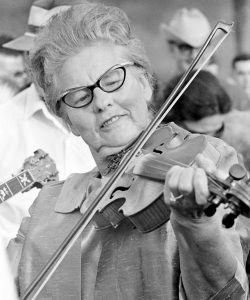
Dorothy Rorick
2/13/1909 – 6/14/1980
Carroll County, Dugspur
Hear Dorothy Rorick play several tunes for folklorist Blanton Owen
From birth, Dorothy Quesenberry Rorick was steeped in the music of the Blue Ridge. She learned to play banjo from her father, “Buck” Quesenberry, at a very young age and was playing at pie suppers and barn “raisings” by the age of eight, beginning what would become a long history of public performance including many appearances at the Galax Old Time Fiddler’s Convention.
Dorothy played a homemade instrument that had been in the family for many years before it was passed down to her by her father. Her family placed great value on music and the instruments they played on. “Down in the holler I remember all we ever had, all every family had to decorate their home in the old days,” She told one reporter, “Was the fiddle and banjo on the wall that we used to entertain ourselves.”
Dorothy’s father taught her a number of ballads as well as many fiddle tunes, many of which later became standards of Appalachian music, including: “Come and Get,” Sally Goodin’,” Cumberland Gap,” Leather Britches,” “John Henry,” as well as many songs brought back from the Civil War. By the late 1930’s, when Dorothy was in her 20’s she elevated her playing from local pie suppers and conventions to radio and recording. After moving to Ohio and getting married, she fronted an all-girl band know as the “Golden State Cow Girls.” During this period, she made frequent trips to Nashville and became friends with such dignitaries as Roy Acuff and Red Foley.
After recording and traveling professionally, Dorothy determined that demand for Appalachian music had died and so she settled down in the 1940’s and took a nearly 30 year hiatus from playing music while she raised a family. Thus, her style and her approach to clawhammer remained frozen in time, a snapshot of 1930’s mountain banjo playing, preserved.
Dorothy’s style of playing clawhammer was uniquely her own as can be heard in the recordings on this page. It is unadorned, pure melody, with a vibrant backbeat but without the melodic trappings of today’s playing. It is in the mountain banjo dialect of the Dugspur area, trapped in time.
In the 1960’s Dorothy ended her long isolation and moved back to the mountains of Dugspur and began to play publicly again, traipsing to all of the SW Virginia and NC festivals and conventions that had grown out of the “folk boom” of the ‘60’s and ‘70’s. Her well preserved style was the subject of much attention by folklorists and other musicians including the legendary guitarist Doc Watson who frequently asked her to join him on stage and in jams.
Due to this attention, Dorothy was recorded by Smithsonian Folkways, Rounder Records, and the Blue Ridge Institute. In 1978, Dorothy was invited to be Virginia’s Delegate to the 40th National Folk Festival at Wolf Trap Farm Park. There she not only played several sets of banjo and ballads, but served on a panel addressing the topic “Why We Held to Our Culture.
Dorothy’s banjo playing wasn’t limited to instrumentals. She uniquely used the banjo to provide rhythmic and modal continuity to the ballad setting, supporting the centuries old melodic contour of these old songs. Dorothy single-handedly preserved, in this manner a number of vanishing ballads from her childhood. Dorothy Rorick held on to her culture and committed to preserving it.