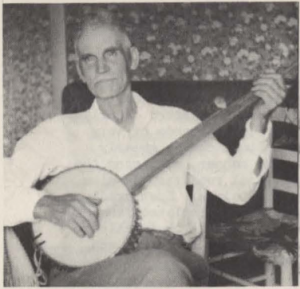
Glen Smith
8/10/1888 – 2/24/1973
Carroll County, Hillsville
Hear Glen Smith play “Sourwood Mountain”
Maybe one of the greatest clawhammer masters of Southwest Virginia, Glen Smith of Hillsville’s remarkable fretless clawhammer playing is often overlooked. This historical oversight may be due to the commonness of “Smith” as a last name, or the fact that there was another, younger musicians by the same name who grew up in the same area and became a great fiddler in West Virginia. For whatever reason, we all need to take a closer look at the banjo and fiddle legacy of this Glen Smith.
Glen grew up on a small farm just out of Hillsville where he lived his whole life. He was born in the twilight years of the 19th Century and was an active participant in the folk revival of the 1960’s. His playing represents a micro banjo dialect related to the broader regional “Galax Sound” that is far different from the nearby Round Peak style. His playing favors a driving, drone rich playing that takes one back to the pre-industrial dance music of early mountain music.
As a young man Glen met and was deeply influenced by two multi-instrumentalists; Wade Ward, of Independence, VA and Uncle Charlie Higgins of Galax. The Carroll County that Glen was born into was isolated and folks did not travel far on ancient red clay roads. Musical styles also did not travel far, either creating a unique “cultural incubation” in which banjo and fiddle styles fermented.
Glen remembered, as a young man, the infamous Carroll County Courthouse shootings of 1912, when Claude Allen and his clan opened fire in the courtroom after a “guilty” verdict was read. This violence, fear, and anxiety this monumental event created is said by folklorists to have affected the music of the region, adding strength and tension to the style. Glen said he never forgot the incident and neither has the region.
Glen, like his friends Wade Ward and Charlie Higgins was both an accomplished fiddler and banjo player. Unlike Wade, who played a resonator style fretted banjo, Glen preferred an open back, utilizing slides and brushes to create dramatic effects. One of Glen’s most famous students, Harold Hausenfluck of Richmond, a blind musician, described Glen’s playing as achieving the “Mountain Whum.”
This “whum” was achieved by Glen both by playing over the neck (a style later emulated by Kyle Creed) and by playing with the slackness of low tunings. Glen often preferred lowering the banjo to E and F tunings. Glen’s left hand percussion was augmented by open string pull-offs by plucking the strings with fingers of the left hand and creating “ghost notes.” Glen was recorded first recorded in 1959 by song collector Peter Hoover of New York, who reportedly told his friends he was “goin’ to Hillsville to record Glen Smith, Wade Ward and Charlie Higgins,” apparently, in Hoover’s mind the “big three of regional old time.
In 1962, The Smithsonian’s Folkways label released “Traditional Music from Carroll and Grayson Counties” recorded by Eric Davidson and Paul Newman, who set out to feature “flailing the banjo” or “thumbnoting” as they called it. Glen is featured solo on “Soldiers Joy,” “Polly Put the Kettle On,” “Cindy,” “Fortune” and other tracks. His playing on this album is a whole lesson in fretless clawhammer style.
Charlie Faurot, another tune collector, captured Glen’s playing for his “Clawhammer Banjo” series and Glen stands out as one of the most featured players on the three record collection. Folkways released the wrongly named “Bluegrass from the Blue Ridge,” in 1967 and again, Glen’s playing was prominent. In 1973, the Smithsonian put together a memorial album of Wade Ward’s playing and Glen is featured on fiddle.
Today, in the region, both Mac Traynham and multi-instrumentalist Lucas Paisley, as well as Mac’s daughter, Hanna Traynham continue to play with Glen’s “mountain whum” in mind. Although often overlooked, Glen Smith’s legacy lives on.