Harold Hausenfluck
3/26/1952 – 7/9/2023
Carroll County, Laurel Fork, Richmond
Hear Harold Hausenfluck play “Lost Indian”
Clawhammer master and fiddler Harold B. Hausenfluck did not live full time in SW Virginia. In fact, for most of his life, he lived much further North, in Virginia’s capitol city of Richmond. Harold’s deep and lasting influence on SW Virginia’s old time music scene is so profound and so undeniable, however that the creators of “Clawhammer Masters of SW Virginia” unanimously agreed to include him here, where we feel he belongs.
Harold Hausenfluck did not come by music easily. Blinded in infancy, his father began searching for ways to find better conduits through which his son could connect with a sighted world. He decided that old time Appalachian music, readily alive and available in SW Virginia would be a great opportunity for his son to connect and he began to immerse Harold in the music, musicians, festivals, and house parties of the region surrounding Galax.
Harold’s first musical instrument was a harmonica that his father got him, and it allowed him to immerse himself in learning the melody lines of hundreds of old time tunes. In 1969, at the age of 17, on a visit to his grandparent’s farm in Highland County, VA., Harold got his first banjo and began to teach himself, in a two finger playing style, translating auditory data into action.
Soon he met a relative who was a renowned clawhammer player named Aunt Lou McCray (a performer for the Grand Ole Opry.) While his father gave detailed descriptions of what Aunt Lou was doing with her right hand and finding the same notes she was playing with his left hand, Harold began to emulate her playing through endless repetition and auditory matching until he got it just right.
This methodology proved to be effective. Once Harold mastered the right hand technique, he found he had an uncanny ability to find the notes on the fretboard. His priority became trying to sound exactly like his auditory subject, to match another’s playing not only note for note, but to match their stroke, intensity and stylistic subtleties. At the same time, he developed the patient listening skills that would serve him well in his chosen work as a piano tuner.
Soon Harold found himself spending summers in SW Virginia, seeking out the masters of his chosen music. He also began to learn fiddle in much the same way he mastered banjo. Soon with his father’s help and the wide acceptance of the old time community across SW Virginia, Harold found himself sitting knee to knee with some of the greatest players of the region. Among them were masters like Matokie Slaughter, Wade Ward, Abe Horton, Glenn Smith and NC clawhammer and fiddle master Tommy Jarrell, as well as Roan Mountain Tennessee’s Birchfield family. Harold developed an insatiable urge to learn the music in its purest form, note for note and brush for brush, exactly how the masters of the genre played it.
One of Harold’s lasting contributions to old time music was his constant hunt for what he called “the mountain whum.” The “whum” was a specific acoustic phenomenon, one that allowed a banjo or fiddle to resonate in a “certain, beautiful manner” where the player and the instrument connected in such a perfect harmonic alignment to produce a deep, forceful and unified sound that would emotionally move the listener. Harold’s super-trained ear made him both an avid critic of the music as well as a thoughtful, enlightened listener. He used these skills to develop a unique teaching methodology in which he developed “learning” tapes and critiques for his many students and followers.
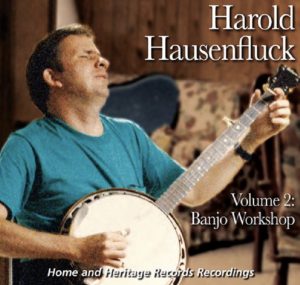
Among those masters of SW Virginia clawhammer that directly learned from Harold were Mac Traynham, Trish Kilby Fore, Andy Buckman, and a whole host of fiddlers. Some of his learning tapes were used to construct two volumes of Harold’s playing and instruction released by the Field Recorder’s Collective. There are currently in circulation many of his tapes and recordings in which he helps listeners understand the intricacies of the SW Virginia masters from whom he learned. He also toured and played with The Roan Mountain Hilltoppers and with his dear friend, Abe Horton.
1n 1999, Harold’s playing career was mostly ended by a severe stroke. However, that didn’t stop his teaching. He developed pirate radio stations both in his home and later in a nursing facility where he continued to critique and teach the intricacies of fiddle and banjo music. In his last years, he returned to the harmonica to play with the many visitors who came to see him.
Harold’s greatest gift to SW Virginia music was the love and dedication that he gave to it, the never ending energy that he devoted to learning and teaching the music, and the precision with which he played and taught. Without this blind master’s devotion, the music would definitely had less “whum.