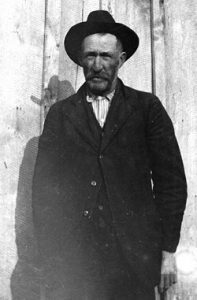
Joe “Dad” Blackard
12/22/1858 – 7/24/1949
Patrick County, Meadows of Dan
Hear Joe Blackard play and sing "Sandy River Belle"
Joe’s Blackard’s place in the history of Virginia folk music is a legendary one. Learning to play clawhammer when he was so small he had to brace the pot on an armchair to reach the neck, Joe’s playing developed during and right after the Civil War. In addition, his ability to learn and sing local ballads from the area made him a primary source for song catcher Cecil Sharpe, who transcribed the words and melodies of timeless ballads brought to the New World from Europe.
His life bridged the powerful transition of rural string band music from an insulated front porch and living room practice to becoming a commercial product, distributed to thousands of homes across the country and the world. His playing and teaching, also, indirectly through his extended family and rediscovery, had a lasting impact on the folk revival of the 1960’s and ‘70’s. He was among those SW Virginia players that helped establish the fiddle/banjo “soul” of SW Virginia’s musical style.
In 1867, Joe began attending the county’s first public school where he was exposed to the region’s variety of musical styles and his clawhammer playing was influenced by the variety of styles coming home with soldiers from the Civil War. He became a teacher in the community and even organized a “subscription school” where those without tuition could attend for free. In 1904, he became a mail carrier, a job that allowed him to hear and collect music from those along his very rural route, adding to and reinforcing his vast repertoire of local music.
Shortly before Blackard recorded his driving clawhammer style, his job afforded him the means to purchase one of the first quality mass-produced banjos, a Sears “Supertone.” Thus, he was squarely positioned to help facilitate the transition of Blue Ridge music from being isolated home entertainment to becoming a national-phenomena. His style was deeply influenced by one of his local musical mentors, fiddler Wallace Spangler, who loved playing fast breakdowns. Blackard also began to mentor a young man that would later become his son-in-law, Jesse Shelor, who would become one of the most influential fiddlers in the area.
In 1919, Blackard’s daughter, Clarice (who had learned the piano from listening to tunes on her father’s banjo) married his student, Jesse Shelor, cementing a lifetime musical collaboration between the two families. In 1927, the Shelor and Blackard families’ musical lives were changed forever. Musician Earnest Stoneman recommended that Joe, Jesse, Clarice, and other Jesse’s older brother, Pyrhus (who also played the fiddle) meet Ralph Peer, of Victor Records in Bristol Tennessee. In August of 1923, the family loaded into a truck and traveled over 125 miles over twisted dirt cow paths to the biggest city most of them had seen.
Upon meeting Mr. Peer, he immediately wanted to know the group’s name. “We’re the Shelor Family,” said Joe. Peer frowned and shook his head, telling them that had no appeal to a wide audience. “Well, then, how about ‘Dad Blackard’s Moonshiners’,” shot back Joe, off the cuff. The name stuck, and they recorded four sides for Peer, including “Sandy River Belle,” “Big Ben (Bend) Gal,” “Billy Grimes the Rover,” and “Suzanna Gal.” Blackard’s driving banjo and his forceful mountain singing are heard on all four cuts.
Although offered a trip to New York to record more tunes for Peer, Joe and his family were content to stay and play in their beloved mountains, building a musical legacy in Meadows of Dan that continues to this day. Clarice and Jesse, along with other family members were recorded again in the 1970’s, sharing once again Joe Blackard’s vast repertoire of local music.