Josh Thomas
1880’s – 1970’s
Roanoke County, Hollins
Hear Josh play "Roustabout"
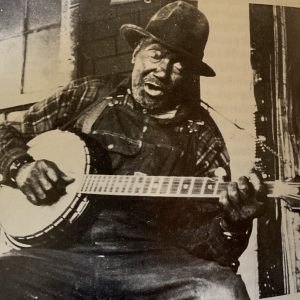
Joshua Latina Robert Thomas was born near the community of Hollins sometime in the 1880’s. Growing up in SW Virginia, he started working when he was a teenager in both the coal fields and in the railroad industry. It was at work that he first heard the banjo and soon had saved enough money to purchase one for himself. He was self-taught, but did note later in life that he had two close cousins who both played the banjo. Thomas told one collector that he thought his cousins were capable players, that is until he actually learned to play the instrument himself.
As a young man, tragedy struck Josh when he was totally blinded during a boxing match. Losing his sight led him to rely more on his musical skills and the feedback that the banjo gave his hands and fingers. He played a fretless banjo in what Mike Seeger famously described as in an “African Virginian” style that echoed the older Black players he had learned from. His family was musical and his half brother was Roland Martin, a fiddle player who recorded with the original Tennessee “Chocolate Drops” in the 1930’s and later headlined the group Martin, Bowen and Armstrong. Despite his blindness, Josh played banjo into his 80’s.
His “African Virginian” style of clawhammer harked back to his father’s time as a slave and represented the oral traditions of the 19th Century Black South. The Black string band traditions were represented in both his style and repertoire. His recordings represent his use of the banjo as a polyrhythmic tool to support a deep resonant vocal style that seems to harken back to field hollers and was described as “unusual” and “archaic” at the same time.
In 1970, field recorder Clifford Endres travelled to Hollins to record Josh. Although he was living at the time in relative obscurity, he demonstrated a style that has fascinated ethnomusicologists, because his playing demonstrated both the dance style of his ancestors as well as the more prevalent “blues” style of playing that had deeply influenced Black Blue Ridge musicians.
Endres recorded more than three hours of Josh’s playing and singing and reported that this was just a small portion of the tunes and songs he knew. The tracks recorded that day appeared on records released by both the Blue Ridge Institute in Ferrum, as well as releases by Smithsonian Folkways. Of interest was Josh’s use of the banjo as a blues instrument, particularly on the track “Mississippi Heavy Water Blues,” where he synthesized his traditional banjo techniques with the thematic concerns of the blues.
Mike Seeger, who found the tapes that Endres made in 1990, became enamored with Josh’s playing would later include Josh Thomas’ version of “Roustabout” in his banjo shows and teaching tapes. He particularly noted Josh’s ability to use the “slide” capabilities of the fretless banjo, which Seeger likened to the human voice. Josh played a banjo made by James Ashborn, a commercial builder who lived in Connecticut, and although few of those banjos have survived, modern day players have sought to reproduce the sound that Josh found on his banjo. On his recording “Southern Banjo Styles,” Seeger not only consciously included Josh’s name alongside legendary players like Dock Boggs and Roscoe Holcomb, but commissioned a replica of Josh’s Ashborn banjo to play and teach “Roustabout” on.
Josh’s influence on clawhammer styles reached a new apex when his playing was discovered by “The Carolina Chocolate Drops.” Banjo and fiddle player Justin Robinson of the “Chocolate Drops” has particularly cited Thomas as a significant source and influence in his style of playing. Thanks to Josh and his cohorts, and the dedicated field recorders who captured their playing, African American and “African Virginian” playing is seeing a new resurgence among young players.