Kyle Creed
9/20/1912 – 11/26/1982
Carroll County, Galax
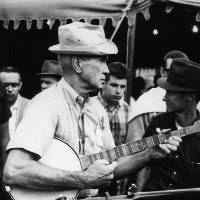
Hear Kyle Creed play “Ducks on the Millpond”
Although legendary banjo player and banjo builder Kyle Creed is often associated with “the Round Peak sound” of Surry County, NC, it is his playing and banjo building that happened after he moved his family to Galax that revolutionized both the sound and the construction of clawhammer banjos that he is most noted for. His contributions to both the sound and the style of clawhammer playing during the major folk revival of the 1960’s and 1970’s changed clawhammer playing and clawhammer banjo construction permanently.
He was born and raised near Beulah in the Round Peak area of Surry County, NC, just down the mountain from Virginia. There he was raised in the thick of Old Time Music listening to his fiddling father, Qualey Creed and his Uncle, John Lowe, and other musicians in the area. Picking up both the fiddle and banjo as a young teen, he spent hours honing his unique style, which included a very vigorous drop and double thumbing technique. He built his first banjo at the age of 16, out of poplar wood, and began to play with many of the local players including fiddler and banjo master Tommy Jarrell, Fred Cockerham, Earnest East, and many other neighbors.
As a young man, Kyle became adept at sawmilling wood for all sorts of uses and learned carpentry skills as he frequently travelled around North Carolina and Virginia. He became quite familiar with all sorts of wood and the properties of the various species. In 1960, he and his wife and two daughters bought a store near Galax, where Kyle could spend more time woodworking and playing music as he tended the store. Soon, he had made contact with his childhood friends and musical mentors and was playing regularly.
When he found out that Fred Cockerham didn’t have a banjo to play, he decided to make one for Fred, hoping it would renew his interest in music. Soon, he and Fred and others had formed the infamous “Camp Creek Boys” and were in demand at dances and fiddling conventions throughout SW Virginia. In addition, Kyle began to build banjos with his own innovations based on his own style and the sounds he liked.
As the demand grew, Kyle began to innovate. Wanting a deeper, haunting sound, he shortened the scale of his banjos so that the bridge could be placed near the center of the pot, providing a “thumpier” sound with lots of bass. To accommodate his own style, he would position his “claw” hand over the neck rather than the head of the instrument, producing a mellow yet haunting sound.
Kyle’s reputation both as a player and builder grew and by the early 1970’s, with the release of several recordings made by his friend and later business partner, Bobby Paterson, Kyle soon had flocks of young people streaming to his store and home, hoping to learn to play the Kyle Creed way. His style, known as “Round Peak” playing quickly became predominant among players of old time. In fact, it got to the point where he told younger player, Walt Koken, that “Now, everywhere I go, I hear myself playin’.”
Among Kyle’s contributions to the art of clawhammer was the use of open tunings that matched the key of the tune he was playing in, utilizing open strings for resonance and sustain. In addition, on his fretless style banjos he experimented with using formica on the fretboard, facilitating fast and wild sliding into the melody with the left hand. He also used the headlamp cover from his Model A to fashion metal picks that allowed him to make precise attacks on the strings and facilitated switching from clawhammer to two finger picking with ease.
Kyle Creed’s contributions to the art and the science of clawhammer playing ushered in the modern day interest in the art and revolutionized the way banjos are built. Kyle’s indelible mark on old time music can be heard anywhere old time music is currently being played.