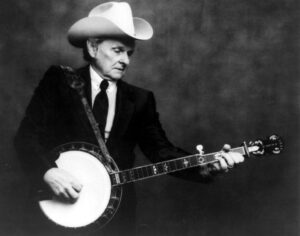
Ralph Stanley
2/25/1927 – 6/23/2016
Dickenson County, McClure
Hear Ralph Stanley clawhammer “John Henry”
Although Dr. Ralph Stanley is hailed as one of the great stalwarts of Bluegrass, he was also a master of clawhammer style banjo and was instrumental in preserving a unique way of playing that grew out of his family’s isolation in the Clinch Mountains. Born the youngest of two brothers, Ralph grew up in a community surrounded by home made music. His mother, Lucy, was a masterful clawhammer player and had 11 siblings, Ralph’s aunts and uncles, that all played banjo.
His father, Lee, was a singer and taught the young boys the ancient ballads of the region like “Man of Constant Sorrow” and “Pretty Polly” as well as the hymns he often led in their local church. Their homelife was one of few comforts with Ralph recalling that for the most part, the family Bible and a deck of playing cards were their only forms of recreation except for the Victrola and a radio from which they listened to and learned the songs of the Carter family and other pioneers of old time music.
When Ralph was 14 and Carter was 16, their parents separated, leaving Lucy to raise the boys on her own. One year later, Lucy scraped the money together to buy Ralph his first banjo, which she purchased from one of his aunts for five dollars. Lucy painstakingly showed him the clawhammer technique she had learned as a young child. She emphasized that he concentrate on developing a solid rhythm to match his older brother’s guitar playing. Soon, the two boys were spending every idle hour learning and playing the tunes around them, changing their lives forever. The first tune Ralph mastered was his mother’s favorite, “Shout Little Luly” which he included in nearly every show he played until his death at 89 years of age.
Ralph’s style, at the time, was unique, because many of the haunting melodies he had learned from his father required playing in modal tunings such as the “Sawmill” or G minor approach that made his music have an archaiac, haunting quality to it. Combined with Carter’s captivating vocals and his own high “lonesome” tenor singing, the brothers developed a unique sound that was true to the music of their ancestory. .
After graduating from high school in 1945 and spending a short stint in the Army, Ralph and his brother began to perform together at dances and parties across the region. After some success on local radio, they formed the “Stanley Brothers and the Clinch Mountain Boys in 1946, modeling their sound after the new “bluegrass” style of Bill Monroe. Ralph concentrated on expanding his playing style to match those of successful new “up picking” players of the era such as Wade Mainer and Stringbean, and later absorbing the three finger rolls of Snuffy Jenkins and eventually Earl Scruggs. Although Ralph moved away from recording his clawhammer playing, he always included at least two numbers in every show that highlighted the style his mother had given him.
By 1949, the Brothers were regulars on WCYB’s “Farm and Fun Time,” out of Bristol, TN. a show that had an enormous following in five southern States. Their unique approach to the music garnered both attention and praise as well as disdain from the “Father of Bluegrass” who felt they were traipsing into his stylistic territory. They signed multi-record deals with Columbia Records and became popular nationwide, until 1966, when tragically, Carter Stanley died from cirrhosis at age 41. Ralph, who always saw himself as the musician/sideman struggled with what to do next. His brother had always been the driving force of their world wide success.
Motivated by thousands of letters from fans, Ralph returned to his home place in the Clinch Mountains in 1967 and reformed the band, recruiting a who’s who list of young singers to replace his brother and found international success until his death in 2016. He performed in movies, “Oh Brother Where Art Thou,” and on world wide television, and was presented with two honorary Doctorate Degrees for his work to preserve mountain music. At the heart of every performance was the unique clawhammer sound that his mother had given him.