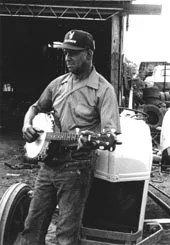
Rufus Kasey
8/3/1918 – 1/19/2001
Bedford County, Huddleston
Hear Rufus Kasey play “Hop Light Lou.”
Clawhammer master Rufus Casey is an outlier among the many masters represented on this map for many reasons. He is unique first and foremost for the manner in which he acquired his style. At the age of eight, he and his brother were given instruments to play with. He got a banjo and his brother acquired a guitar. Together, they taught themselves to play their respective instruments in relative isolation. Neither of the two had parents or relatives that played instruments, although their community of Huddleston was full of gospel and blues music.
By the time they were teens, the brothers were playing regularly for family gatherings and were frequent entertainers at the nearby “juke joint,” on weekends. As they entered adulthood, Rufus’s brother, George moved to Wilmington, DE where he became a known blues player. Rufus stayed at home in Huddleston, bought an automobile junkyard, and became one of the largest parts dealers in the region.
While Rufus sat in the junkyard waiting for orders, he entertained his customers with his home-grown style of clawhammer, modeled off of his brother’s guitar playing and his natural abilities to hear a tune and memorize both the melody and the words. Soon his repertoire grew, and so did his ability to wind stories and tales throughout his music.
When Rufus acquired a tow truck, his business grew exponentially. He and his family lived on the Smith Mountain Lake Parkway, smack in the middle of their growing auto graveyard. Farmers, car dealers, and companies sought out his parts and repair skills, and when they visited, they most likely got a tune or two from Rufus’ banjo. Besides raising seven children, who produced 38 grand and great grandchildren, the two shared another occupation, they both drove school busses for the local district.
Music was the joy Rufus found in a hard life. He attended a small rural school until the seventh grade that was in the shadow of the all-white Mt. Pleasant Academy, They boys from the white school would often wait for Rufus to leave his school building and then pounce on him as he walked home. “They’d beat me up about every day,” Rufus told a reporter, “But it was better than workin’ at home.”
Kasey, who was brilliant, tried to attend the higher grades but was turned away by a system that wouldn’t let young Black men go beyond the 7th grade. Kasey possessed two phenomenal natural talents, though, that served him well in life. One was his innate ability to play the banjo and the second was an incredible gift of storytelling. Whether he was in his shop selling parts or in the “juke joint” singing and playing native tunes, he always attracted a crowd of admirers.
His clawhammer playing was strictly his own style, learned by hours and hours of trial and error. The fact that he developed his rhythmic attack in the traditional clawhammer style speaks to both his status as a Black player carrying on a tradition brought from Africa and then developed in Jamaica and brought to North America, speaks both to his musical ingenuity and to his genealogy.
In the 1970’s folklorist Kip Lornell from Ferrum College visited him and recorded him, praising his bluesy style of banjo and his singing voice. From that point on, he was regularly featured at the Blue Ridge Folklife Festival, where large crowds gathered to hear him play and sing. He was featured on collections released by the Smithsonian, Rounder and Folkways records.
Rufus legacy lives on in many of his descendents. Among them are musicians who play blues, classical and jazz music professionally and Rufus and his music are always remembered at the very large family gatherings he so loved.